Drone LiDAR for Real Estate Development: Faster Surveys, Lower Costs, and Smarter Site Decisions
What Is Drone LiDAR and Why Developers Are Adopting It
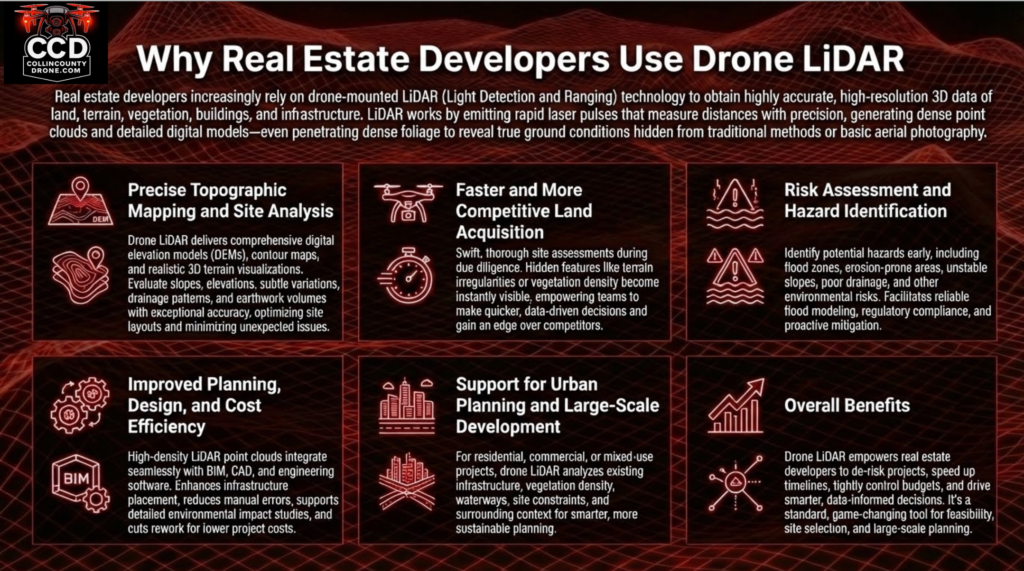
Real estate developers are increasingly using drone-mounted LiDAR (Light Detection and Ranging) to capture highly accurate, high-resolution 3D data of land, terrain, vegetation, buildings, and infrastructure.
LiDAR works by emitting rapid laser pulses that measure distances with extreme precision, creating dense point clouds and detailed digital terrain models. Unlike traditional surveying or aerial photography, drone LiDAR can penetrate dense vegetation, revealing true ground conditions hidden beneath trees and brush.
This level of accuracy allows developers to make faster, data-driven decisions during land acquisition, feasibility studies, and project planning.
Precise Topographic Mapping and Site Analysis
Drone LiDAR delivers comprehensive digital elevation models (DEMs), contour maps, and realistic 3D terrain visualizations that dramatically improve early-stage planning.
Developers can accurately evaluate:
Slopes and elevation changes
Drainage patterns and water flow
Earthwork volumes
Buildable areas and site constraints
With precise terrain intelligence, teams optimize site layouts early and minimize unexpected grading or construction challenges later.
Faster Land Acquisition and Competitive Advantage
In competitive real estate markets, speed is critical. Traditional surveys can delay due diligence for weeks, while drone LiDAR surveys provide actionable insights within days—or even hours.
Hidden terrain irregularities, vegetation density, and access limitations become immediately visible, allowing developers to:
Evaluate multiple parcels quickly
Reduce acquisition risk
Make confident purchase decisions faster
This accelerated workflow gives developers a measurable advantage over competitors relying on slower conventional methods.
Risk Assessment and Hazard Identification
Accurate elevation data is essential for identifying environmental and regulatory risks before development begins.
Drone LiDAR helps detect:
Flood zones and low-lying areas
Erosion-prone terrain
Unstable slopes
Drainage and runoff issues
Reliable terrain modeling supports flood analysis, permitting compliance, and insurance evaluation—helping prevent costly redesigns, delays, and compliance challenges later in the project.
Improved Planning, Design, and Cost Efficiency
High-density LiDAR datasets integrate seamlessly with BIM, CAD, and engineering platforms, enabling more accurate and efficient project design.
Key benefits include:
Precise infrastructure placement
Reduced manual measurement errors
Better environmental impact analysis
Fewer design revisions and field corrections
Better data early in development translates directly into reduced project costs and improved resource allocation.
Supporting Urban Planning and Large-Scale Developments
For residential subdivisions, commercial sites, and mixed-use projects, drone LiDAR provides a complete understanding of the surrounding environment.
Developers gain insight into:
Existing infrastructure and utilities
Vegetation density and preservation zones
Waterways and drainage corridors
Site constraints and neighboring impacts
This comprehensive analysis improves planning outcomes while supporting sustainable and scalable development strategies.
How Drone LiDAR Reduces Feasibility Survey Costs
One of the biggest advantages of drone LiDAR is its ability to dramatically lower pre-development survey expenses while improving accuracy.
Massive Reduction in Field Time and Labor
Traditional ground surveys often require large crews working for days or weeks across difficult terrain. Drone LiDAR can survey hundreds of acres in hours, achieving 60–95% time savings with only one or two operators.
Lower Survey Costs Per Acre
Conventional feasibility surveys may cost $500–$1,000+ per acre. Drone LiDAR typically ranges between $30–$150 per acre, with many projects reporting 30–70% total cost savings.
Fewer Reworks and Design Changes
Accurate, vegetation-penetrating terrain data enables reliable earthwork calculations and flood modeling from the start. Developers frequently reduce rework by 25% or more, avoiding expensive downstream corrections.
Scalable Due Diligence for Multiple Sites
Drone LiDAR allows teams to assess 100+ acres in a single day, accelerating decision-making and reducing opportunity costs tied to unsuitable properties.
Why Drone LiDAR Is Becoming the New Standard in Land Development
As land development becomes more competitive and data-driven, drone LiDAR is quickly evolving from a specialty service into a standard workflow tool.
By combining speed, precision, and cost efficiency, drone LiDAR helps developers:
Reduce project risk
Accelerate timelines
Control budgets
Improve planning accuracy
Maximize return on investment
Developers who adopt LiDAR early gain clearer insights, stronger feasibility analysis, and better-performing projects from day one.
Frequently Asked Questions About Drone LiDAR for Real Estate Development
What is drone LiDAR and how does it work?
Drone LiDAR (Light Detection and Ranging) is a surveying technology that uses laser pulses emitted from a drone to measure distances to the ground and surrounding features. These measurements create highly accurate 3D point clouds and digital terrain models. Unlike traditional aerial imagery, LiDAR can penetrate vegetation, allowing developers to see true ground elevations even in heavily wooded areas.
Why is drone LiDAR better than traditional land surveying?
Drone LiDAR collects data significantly faster and often with greater terrain detail than conventional ground surveys. Traditional surveys require crews physically walking a site, which can take days or weeks. Drone LiDAR can map hundreds of acres in hours while capturing millions of elevation points, reducing labor costs, improving accuracy, and minimizing delays during feasibility studies.
How accurate is drone LiDAR for real estate development?
Modern drone LiDAR systems typically achieve vertical accuracy within a few centimeters when properly calibrated and processed. This level of precision is sufficient for topographic mapping, drainage analysis, earthwork calculations, and early engineering design, making it highly reliable for site planning and due diligence.
How much does a drone LiDAR survey cost per acre?
Costs vary depending on terrain complexity, vegetation density, and project size, but drone LiDAR surveys commonly range between $30 and $150 per acre. Larger projects often receive volume pricing, and many developers see overall survey cost reductions of 30–70% compared to traditional surveying methods.
Can LiDAR see through trees and vegetation?
Yes. One of LiDAR’s biggest advantages is its ability to penetrate gaps in vegetation. Laser pulses reach the ground beneath trees and brush, allowing accurate terrain modeling even in densely wooded areas where photogrammetry or visual inspections fail.
When should developers use drone LiDAR in a project?
Drone LiDAR provides the most value during early project phases, including:
Land acquisition and due diligence
Feasibility studies
Site selection and planning
Environmental and flood risk analysis
Pre-engineering surveys
Using LiDAR early helps identify risks before major investments are made.
Does drone LiDAR replace traditional surveys?
Drone LiDAR does not completely replace licensed boundary or legal surveys, but it significantly enhances and accelerates topographic and feasibility surveys. Many surveyors now combine LiDAR data with ground control measurements to produce faster and more comprehensive results.
How does drone LiDAR reduce development risk?
Accurate elevation and terrain data help developers identify flood zones, unstable slopes, drainage problems, and site constraints early. Detecting these issues before design or construction prevents costly redesigns, regulatory complications, and unexpected construction expenses.
Is drone LiDAR useful for large-scale developments?
Yes. Drone LiDAR is especially valuable for large residential, commercial, and mixed-use developments. It allows rapid mapping of hundreds of acres, supports master planning, and provides consistent data across entire project sites, improving coordination between engineers, planners, and stakeholders.
How quickly can a drone LiDAR survey be completed?
Many projects covering 100 acres or more can be captured in a single day, with processed deliverables typically available within a few days depending on project complexity. This dramatically shortens feasibility timelines compared to traditional surveying workflows.