General Benefits of Drones in Construction
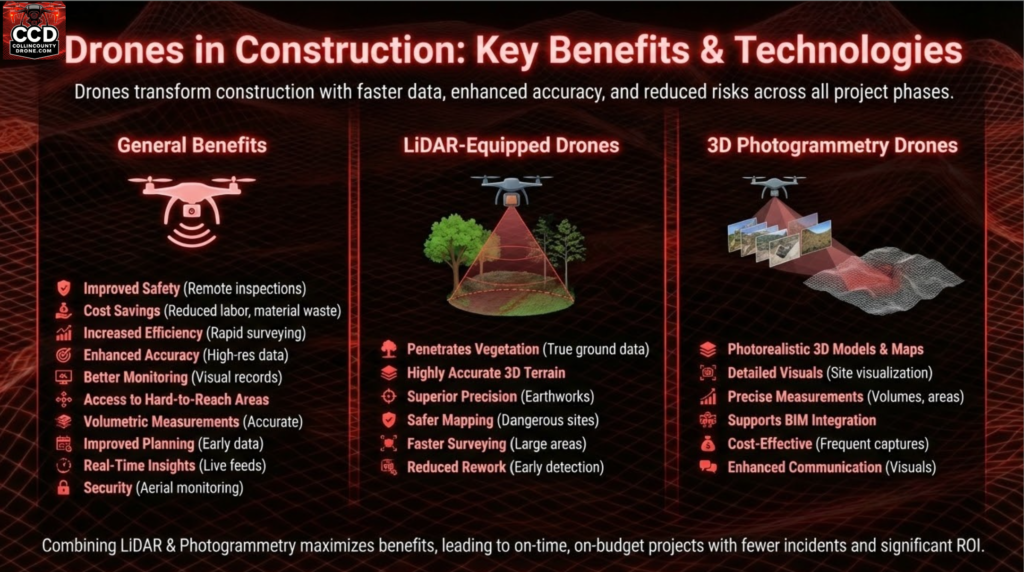
- Improved Safety
Construction sites are full of hazards—tall structures, unstable slopes, confined spaces, busy roadways, and heavy equipment. Traditionally, inspections required workers to climb scaffolding, use cranes, or enter risky areas.
Drones eliminate much of that exposure.
They enable:
- Remote inspections of rooftops, facades, bridges, and towers
- Real-time hazard detection
- Reduced fall and injury risks
- Safer assessment of unstable or contaminated zones
By minimizing physical exposure, drones significantly improve on-site safety.
- Cost Savings
Time is money in construction—and drones save both.
They reduce the need for:
- Scaffolding and cranes
- Large survey crews
- Repeat site visits
Early detection of grading issues, drainage conflicts, or design deviations also minimizes costly rework. Many firms report a rapid return on investment due to improved efficiency and reduced material waste.
- Increased Efficiency and Speed
Traditional surveys that once took days or even weeks can now be completed in hours.
Drones:
- Cover large sites quickly
- Capture high-resolution data in a single flight
- Deliver rapid processing results
- Enable faster decision-making
This acceleration helps projects stay on schedule and adapt quickly to changing conditions.
- Enhanced Data Accuracy and Precision
Manual measurements can introduce errors. Drone-based systems provide highly accurate imagery and measurable data.
Benefits include:
- Precise topographic maps
- Accurate volume and cut/fill calculations
- Reliable 3D models
- Reduced human error
Better data means better planning—and fewer surprises.
- Better Progress Monitoring and Documentation
Regular drone flights create a visual timeline of project development.
This allows teams to:
- Track percentage completion
- Compare actual progress to schedules
- Validate contractor work
- Maintain digital records for dispute resolution
Stakeholders can receive visual updates without physically visiting the site, improving communication and transparency.
- Access to Hard-to-Reach Areas
Drones can easily inspect:
- Tall facades
- Bridges
- Roof systems
- Dense vegetation
- Remote infrastructure corridors
All without interrupting site operations.
- Stockpile and Volumetric Measurements
Drones provide highly accurate material volume calculations for:
- Earthmoving operations
- Aggregate inventory
- Cut/fill analysis
- Forecasting and procurement planning
This reduces overordering, prevents shortages, and improves financial forecasting.
- Improved Site Planning and Design
Early drone surveys provide valuable topographic data that supports:
- Budgeting accuracy
- Grading strategies
- Drainage planning
- Integration with BIM (Building Information Modeling)
Better early-stage data leads to smoother project execution.
- Real-Time Insights and Collaboration
Live video feeds and processed 3D models allow remote teams to:
- Monitor site activity
- Identify issues instantly
- Coordinate between offices and field teams
- Make faster, data-driven decisions
This strengthens collaboration across project stakeholders.
- Security and Theft Prevention
Aerial monitoring enhances site security by:
- Tracking equipment movement
- Detecting unauthorized access
- Creating recorded surveillance archives
Construction sites are frequent theft targets—drones add an extra layer of oversight.